 JAMES CUBITT INTERIORS
Incubitt · Thought Leadership
Leadership Under Pressure: Lessons from Architecture, Business and Superbike Riding
What a fit-out on a fixed deadline, a tough Monday meeting and a superbike on Third Mainland Bridge teach about leading when the plan breaks.
By Femi Sotubo
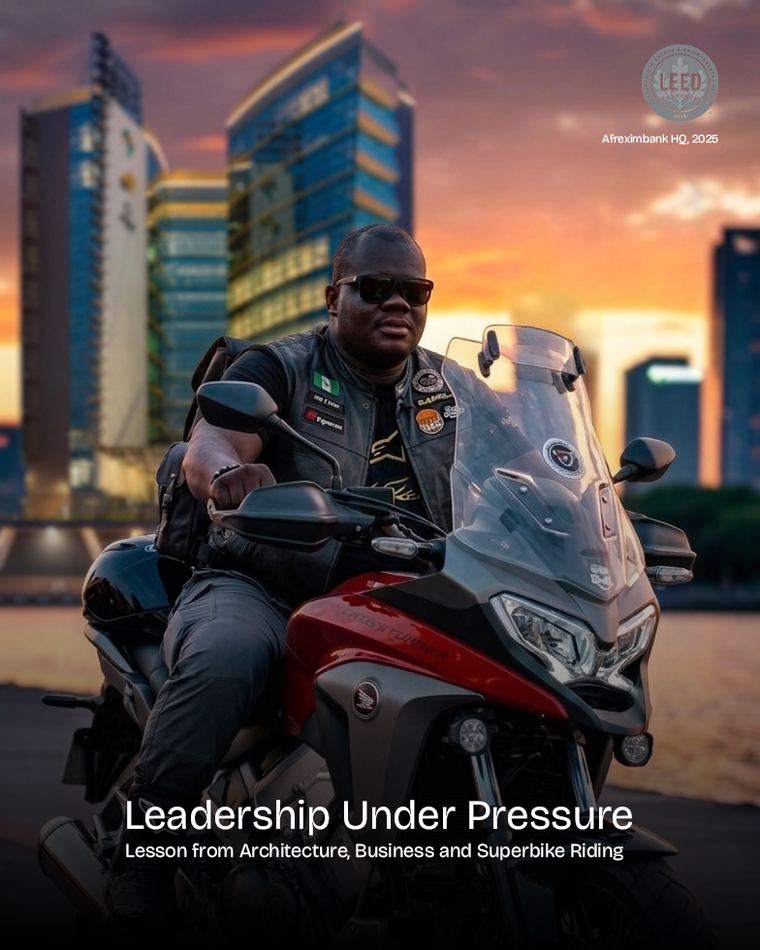
Leadership is tested when the plan breaks.
I’ve learned this in three very different high-stakes places: on a complex construction project halfway between “approved” and “completed”; in a Monday morning management meeting when the numbers don’t behave; and on a superbike at 5:30 pm on Third Mainland Bridge, surrounded by the organised chaos Lagos traffic is famous for.
Leadership in our industry isn’t very different. To lead a project through the noise of today’s market, you have to move beyond the rigid fantasy of the “perfect drawing” and master something far more valuable: the art of the pivot, without losing your intent, your standards or your calm.
Pressure tests composure.
1. When the Drawing Meets Reality
A few years ago, we were midway through a multi-million naira office fit-out. The kind of job that looks neat in early presentations: lovely renders, tidy schedules, confident milestones, until reality arrives with its usual toolkit of delayed deliveries, supplier surprises, cost spikes and shifting site conditions.
Materials slipped. The programme was already tight. And the client’s move-in date wasn’t a “target”; it was a fixed point. The office had to open. People had to sit at desks. IT had to run. The business needed the space to function.
This is the moment where leadership shows up, because the easy option presents itself immediately: blame procurement, blame delayed client payments, blame the contractor, blame the market, blame “circumstances”.
But nobody cares who gets the blame when a move-in date is staring them in the face.
Blame is not a schedule strategy.

2. The Illusion of Control
Architectural drawings are seductive because they suggest certainty. Plans align. Elevations are clean. Visuals are curated. The building “exists” perfectly before a single block is laid. It’s useful, necessary even, but still an illusion.
Then reality arrives: a supplier misses the lead time. A material becomes unavailable. A cost jumps. A neighbouring tenant complains. A ceiling void hides services that were never recorded. A “simple detail” becomes complicated the moment it’s scaled up and installed under pressure.
If you lead as though you’re entitled to perfect conditions, you’ll constantly be offended by reality. And that offence becomes the seed of bad decisions.
On a high-performance motorcycle, control is never absolute. You’re managing forces, speed, traction, balance, surface conditions and other road users, most of which are not fully predictable. You can’t bully physics. You can only cooperate with it.
Overreact, and you meet instability. Hesitate, and you lose balance. Panic, and you create the very outcome you were trying to avoid.
3. Discipline Before Drama
There’s a misconception in high-pressure environments that leadership must be loud: dominate the room, speak the most, drive hard and appear fearless.
But in real delivery, loud leadership often becomes noise. And noise is not directional.
The truth is, leadership is discipline. In business development, charisma may open doors, but preparation keeps you in the room. You win by understanding systems, anticipating objections, knowing where risk hides and planning before risk shows up.
On a motorcycle, discipline keeps you upright: checking mirrors, maintaining space, assuming you haven’t been seen, planning escape routes, staying alert to surface changes.
You don’t ride safely by hoping other people behave. You ride safely by assuming unpredictability is normal.
In architecture and project delivery, discipline is the same principle in a different outfit: documentation, governance, communication and structure.
Respond deliberately. Stabilise, then decide.

4. Teams, Brotherhood and Trust
The motorcycling community has a quiet rule: when one rider stops, everyone stops. It’s not sentimental; it’s practical. On the road, you’re vulnerable, and mutual support can be the difference between a small inconvenience and a serious situation.
Architecture is no different. No project succeeds because of one brilliant individual. It succeeds because teams align: architects, engineers, contractors, suppliers, project managers and clients, each moving at different speeds under shared pressure.
When things are smooth, anyone can look competent. When things get tight, the question becomes: do people protect their territory, or protect the project? Do they hoard information, or share it early? Do they point fingers, or solve problems?
Under tension, trust becomes currency. And trust isn’t built by speeches. It’s built by patterns: say what you’ll do, then do it; raise issues early; admit mistakes quickly; make decisions that are consistent and fair.
Trust is built by patterns, not speeches.
5. What This Means for Clients and Businesses
If there’s one thing clients should look for in a design partner, it isn’t just creativity. It’s composure.
Creativity matters; nobody wants a lifeless space. But in today’s environment, beauty alone is not enough. When supply chains wobble and costs fluctuate, the question is: can your team protect the intent while adapting the method?
The practical questions to ask are simple. Can your team think clearly when the programme compresses? Can they protect the budget when the scope expands or prices shift? Can they advise honestly when decisions carry long-term operational consequences? Can they simplify complexity without dumbing it down? Can they lead the room when everyone is stressed?
Momentum is powerful. But direction matters more. You can move quickly and still crash, on a bike, on a project or in a business. The goal is controlled progress, not frantic motion.
At James Cubitt Interiors (JCI), we start each project with a simple assumption: complexity will arise. Not because we’re pessimists, but because we’re realistic. The built environment rewards leaders who plan for friction, not leaders who act surprised when it shows up.
Final Thought
A superbike teaches you respect for power. Architecture teaches you respect for stability. Business teaches you respect for consequences.
Leadership lives at the intersection of all three.
About the author
 Femi Sotubo, Manager, Projects and Business Development, James Cubitt Interiors
Femi Sotubo is Manager, Projects and Business Development at James Cubitt Interiors (JCI). With 14 years at JCI, he leads complex project delivery and commercial strategy, focused on disciplined execution in volatile market conditions.